

When a Life Stops Fitting
The difficult permission to outgrow what once made sense.

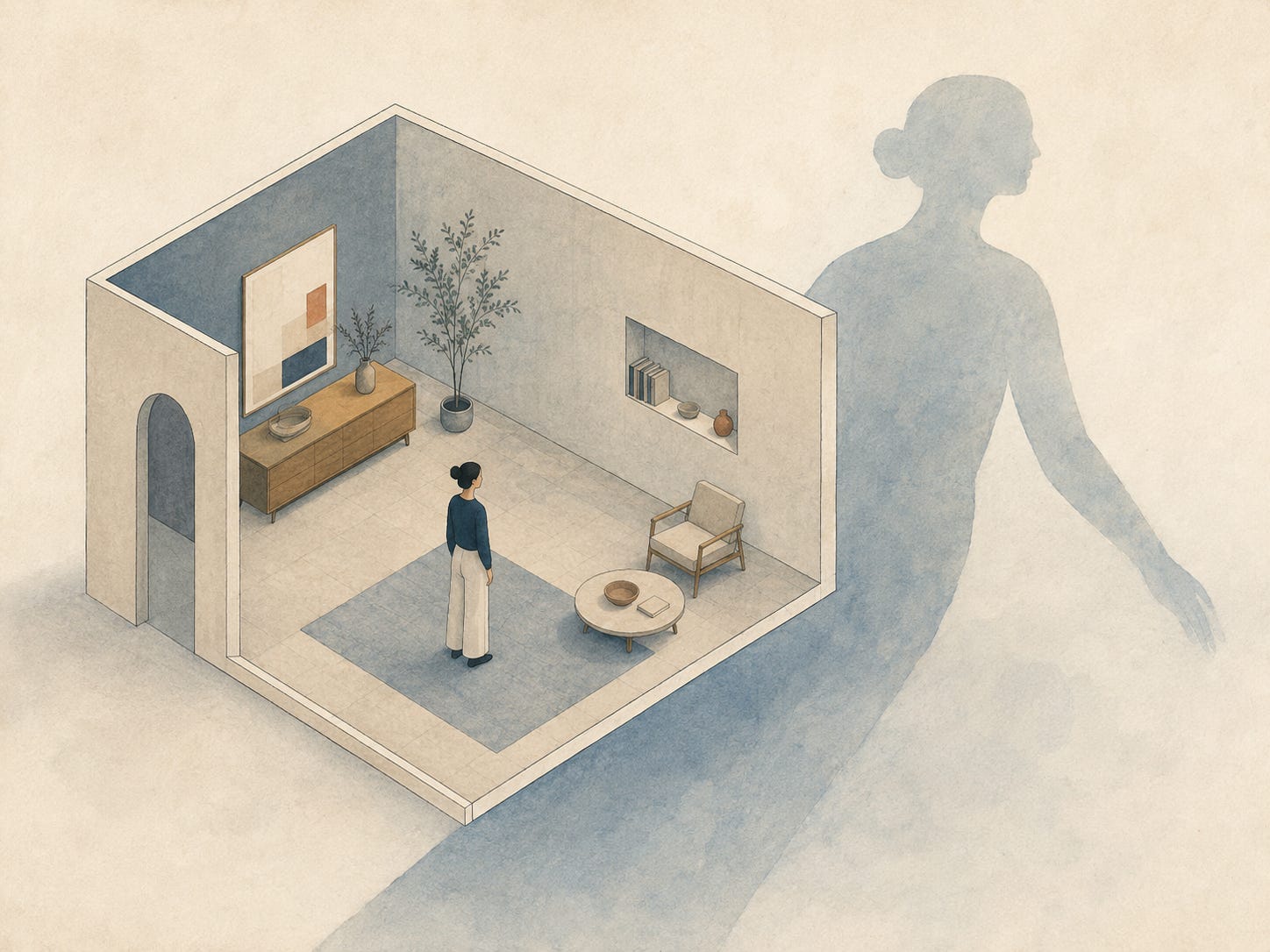
“The future enters into us, in order to transform itself in us, long before it happens.”— Rainer Maria Rilke
When a Life Stops Fitting
The difficult permission to question what still seems to work.
Some lives break down completely. Others work almost too well.
The job is fine. The relationship functions. The routines make the days manageable. Nothing is asking for our immediate attention, and the people around us may believe we are doing well. We may believe it too.
That is what makes these lives so difficult to question.
We know what to do when something breaks, or at least we understand why someone would want to do something. There are words for crisis, betrayal, failure, and loss. When the pain becomes visible enough, change begins to feel permissible. Sometimes it even becomes expected.
But what gives us permission to question a life when nothing is really wrong?
I have been thinking about how easily a life can become static without becoming obviously unhappy. We find work that works, a relationship, a way of organizing our days, and naturally, we want to preserve it. Why would we interfere with something that is not causing us trouble?
So we continue.
The same routines. The same conversations. The same way of explaining ourselves to ourselves.
Comfort is not the enemy. I do not believe we should distrust every peaceful season or create problems to feel that we are growing. But comfort can make certain questions feel unnecessary, and after enough time, unnecessary questions become almost impossible to ask.
We stop choosing the life and begin maintaining it. From the outside, the two can look exactly the same.
There is also a social performance involved in all of this. Most of us learn very early that we are expected to appear reasonably okay. Someone asks, “How are you?” “Great.” “Good.” “Busy, but good.”
The question usually does not mean: Please stop here and examine your life in front of me. It is more often a request for reassurance that things are proceeding as expected.
If we interrupt the ritual and give an honest answer, people do not always know what to do with it. Sometimes we do not know what to do with it either.
We have been taught to present ourselves in something close to an optimal state: productive, grateful, emotionally stable, moving forward. Not necessarily extraordinary, but functional. Put together. Fine.
The performance is not always dishonest. We may actually be fine. But “fine” is a strangely effective place to hide from ourselves.
We tend to question what hurts. We question the job after we begin dreading Monday mornings. We question the relationship after the distance has become impossible to ignore. We question our beliefs after something happens that they cannot explain. We wait for life to become uncomfortable enough to justify our attention.
We are less used to questioning what appears to be succeeding.
Maybe that is because we imagine reflection as a form of repair. Something has gone wrong, so now we must understand it. But reflection is also how we notice that something continues to work even when it is no longer fully ours.
Not every accidental life was chosen by somebody else.
Some are built from decisions we made ourselves.
Of course, even the choices we call our own did not begin in empty space. We did not choose where we were born, the family we entered, the religion we were raised with, whether we had brothers or sisters, the opportunities we encountered, or the fears we absorbed before we could name them. All of those things shaped what later appeared possible, desirable, or sensible to us.
We like the idea of being self-authored. It is reassuring to believe that we stood before all the possible lives and selected this one freely. But none of us chose from all the possible lives. We chose from the lives we could imagine at the time.
I do not know how free our will really is. Philosophers have spent far more time on that question than I have, and I am not sure the argument can ever be settled from inside the experience of being human.
I am also not sure it changes what we have to do.
We experience ourselves as choosing. We live with the consequences as though we chose. That may be reason enough to take our choices seriously, without pretending they were ever completely free from everything that came before them.
At some point, we picked a direction. Maybe we thought it through carefully. Maybe we were brave. Maybe it was what we needed then.
After that, the choice began producing other choices. A career brought responsibilities. A relationship shaped an identity. An ambition organized our time. A role taught other people what to expect from us. Eventually, the life acquired enough momentum that continuing no longer felt like a decision.
It just felt like life.
This is one of the ways we lose contact with our agency. We do not surrender it all at once. We allow an old decision to keep making new decisions for us.
I chose my children’s school four years ago. But in another sense, that decision was not made four years ago. I make it again every morning when I take them there.
Tomorrow, I could make a different choice. There would be consequences, complications, and explanations. I might decide that changing schools would be a terrible idea. The point is not that I should choose differently. The point is that continuing is also a choice.
Inertia does not feel like one. It feels like an obligation, or like what we do.
The same thing happens in much larger parts of our lives. We remember the moment when we chose the job, the partner, the city, the belief, or the direction. We do not notice all the quiet mornings on which we choose it again.
Perhaps this is why we place so much value on consistency. A consistent person seems trustworthy. Predictable. Put together. Someone who finishes what they start, keeps their promises, and does not reinvent their life every time something becomes uncomfortable.
There are good reasons to value this. We cannot build anything meaningful if every difficult season becomes evidence that we chose incorrectly. Commitment requires us to remain when enthusiasm fades. Love is not always easy. Growth often feels inconvenient while it is happening.
But I wonder if our admiration for consistency also comes from the way we distinguish adults from children.
Children are allowed to change constantly. One day avocado is their favorite food; the next day they are offended that we placed it on the plate. Someone is their best friend on Tuesday and, by Thursday, apparently never has been. They want to be an astronaut, then a soccer player, then something that does not yet have a name.
We find this amusing because children are still becoming. Adults, on the other hand, are expected to have become.
We are supposed to know what we like, what we believe, what we want, and who we are. Congruence becomes evidence that we have assembled a coherent self and learned to function in the world.
There is comfort in that, for us and for everyone around us. A predictable identity makes relationships easier to navigate. People know which version of us will arrive. We know which version to present.
Then something changes.
Perhaps we notice that we no longer believe what we have continued saying. Or that what once gave us energy now mostly gives us structure. Perhaps a role still fits well enough, but only because we have become very good at making ourselves smaller inside it.
The realization threatens more than the choice itself. It threatens the stability and predictability that have gathered around it.
If I question this, what else might move?
Who might be disappointed?
What if I discover something I cannot undiscover?
It is more comfortable not to ask.
I understand that impulse. I have avoided conversations because I knew that once something was said aloud, the relationship could not return to the version that existed before it. Even if nothing outwardly changed, we would know.
Silence preserves the structure.
Conversation introduces movement.
Sometimes the conversation strengthens what we were afraid might break. Sometimes it does break it. Usually, we do not know which will happen beforehand. That is why avoiding the question can feel like an act of protection.
But we should be honest about what we are protecting. Sometimes it is the relationship or the commitment. Sometimes it is our ability to keep experiencing it without having to make another decision.
There is another difficulty here: we want things that matter to last.
We speak about important relationships using the language of permanence. We promise forever. We imagine that if something ends, it somehow failed to become what it should have been.
I have romanticized friendship this way. Part of me has wanted the people I love to remain who they were to me and for what existed between us to retain its meaning by retaining its form. When a friendship changed, I often struggled not only with the loss of the person or the closeness, but with the feeling that the ending had rewritten everything that came before it.
But nothing is promised permanence.
I learned this in a way I was not prepared for when I became a father.
One of my children had a health problem shortly after I entered parenthood. Fortunately, he is healthy now. But at the time, I had to confront something no one had mentioned when they spoke to me about becoming a parent.
Becoming a father not only opened the possibility of loving someone in a way I had never loved before. It also opened the possibility of losing him.
That possibility had always been contained inside the love, from its very beginning. I simply had not understood that I was accepting both.
We enter relationships, families, ambitions, and entire versions of our lives wanting to believe that the important ones will remain. I do not think we are wrong to want that. Permanence is one of the ways we try to make ourselves safe inside a world that refuses to promise it.
But things can matter without lasting forever.
A relationship can shape us without accompanying us for the rest of our lives. An ambition can give direction to one chapter without deserving control of every chapter that follows. A belief can help us understand the world until we become capable of asking a question it can no longer answer.
This is not an argument for treating people or commitments as disposable. Nor is it permission to leave whenever staying becomes uncomfortable. Sometimes remaining is the courageous choice.
Sometimes leaving is.
Often, the more difficult task is being honest enough to discover which one we are actually making.
When a life stops fitting, there may be no dramatic revelation. More often, something becomes harder to ignore. We are unusually tired. We begin envying people whose lives we never thought we wanted. A plan that once excited us now requires us to perform excitement for other people.
Or nothing feels wrong until we step outside our normal life.
We travel. We meet someone. We read a sentence at the right moment. We spend an afternoon alone without the usual demands telling us who to be.
For a moment, we encounter another version of ourselves. Not necessarily a happier one. Just someone more awake.
Then we return, and something that once felt natural begins to feel rehearsed.
Not every feeling is an instruction. Not every fantasy should become a plan. I have wanted things that would not have been good for me, and I have felt restless inside commitments that were still worth keeping.
But a feeling does not need to be obeyed in order to be heard.
We can ask what it is showing us before deciding what, if anything, it requires.
Our minds tend to jump toward the most dramatic possibilities. Quit the job. End the relationship. Move somewhere else. Begin again.
Occasionally, that is where an honest examination leads. More often, the first change is less visible. A role needs new boundaries. A relationship needs the conversation we have postponed. An ambition needs to become smaller, or perhaps more honest. A definition of success needs to be separated from the audience it was designed to impress.
Sometimes it is not the work that no longer fits, but the person we believe we must be while doing it.
It is not the relationship, but the silence we have mistaken for peace.
It is not the responsibility, but our belief that carrying it well means carrying it alone.
We may not need a different life. We may need to recognize that we are still designing the one we already have.
That is easy to forget because most of life is repetition. We wake up and continue what we were doing yesterday. The continuity makes our circumstances appear fixed, but they are also being constructed by all the small decisions we barely experience as decisions.
Living deliberately cannot mean designing a life once and then following the plan forever.
If anything, it means remembering that the design is still happening.
I have spent a considerable part of my life looking back at choices I once made with confidence. Some became foundations. Some became detours. Some protected me for a while and then limited me in ways I was slow to recognize.
My instinct is often to judge the person who made them.
Was I right?
Was I wrong?
Should I have known?
Did I stay too long?
I can spend a great deal of time trying to reach a verdict, as if the purpose of reflection were to place my former self on trial.
But I did not know then what I know now.
That sounds obvious. It is also something I repeatedly resist accepting.
I made those decisions with the awareness available to me at the time. Since then, I have lived through consequences I could not fully predict. I have discovered needs I did not know how to name. I have learned the cost of things that once appeared free.
Perhaps I chose well.
Perhaps choosing well does not mean choosing forever.
We often imagine deliberate living as getting the important decisions right: the right work, the right person, the right beliefs, the right life.
I no longer think any choice can permanently relieve us of the responsibility to stay awake.
The question is not only, “What did I choose?”
It is also, “What am I choosing now?”
Do I still believe this?
Do I still want this?
Am I remaining because staying expresses love, patience, and integrity—or because I no longer know who I would be if I left?
There may not be a clean answer. Questioning a life does not guarantee that we will understand it better immediately. For a while, it may only make us less comfortable inside it.
But discomfort is not always evidence that something has gone wrong.
Sometimes it is what becoming conscious again feels like.
A life does not need to become unbearable before we are allowed to examine it. We do not need a crisis to reconsider a choice, and we do not need a villain to explain why something has changed.
We can recognize that something has ended without deciding that it failed.
We can grieve it without disowning it.
A life may have held us, instructed us, and given us the place from which we became able to see beyond it. Pretending it still fits does not honor what it gave us.
And perhaps that is the difficult permission: not permission to leave, necessarily, but permission to look. To interrupt the momentum. To admit that continuing is also a decision.
Then, without prosecuting the person who chose before us and without demanding certainty from the person we are becoming, to ask the question again:
What would I choose now?
A personal note
For the past several months, I have been working on a book I named DELIBERATELY.
It grew from years of asking questions like the one beneath this essay: How much of the life we are living was consciously chosen, and how much just continued?
The book will be published on September 11. Before then, I would like to share it with a small circle of early readers.
I am not looking for praise or even agreement. I am looking for thoughtful people willing to spend some time with the book and tell me what stayed with them, what unsettled them, and where they recognized themselves in its pages.
If this sounds like a book you would genuinely like to spend time with, reply to this email and tell me what draws you to it. I will share advance copies with a small group of readers over the coming days.
Recommended Reading
“Transitions: Making Sense of Life’s Changes” by William Bridges
Bridges makes an important distinction between change (the external event) and transition, the internal process through which we slowly release one identity before another is formed. Particularly valuable is his understanding that every beginning contains an ending, and that what lies between them is not wasted time but disorientation