

Like a Brother
On friendship, expectations, and the people we promote into roles they never agreed to play.

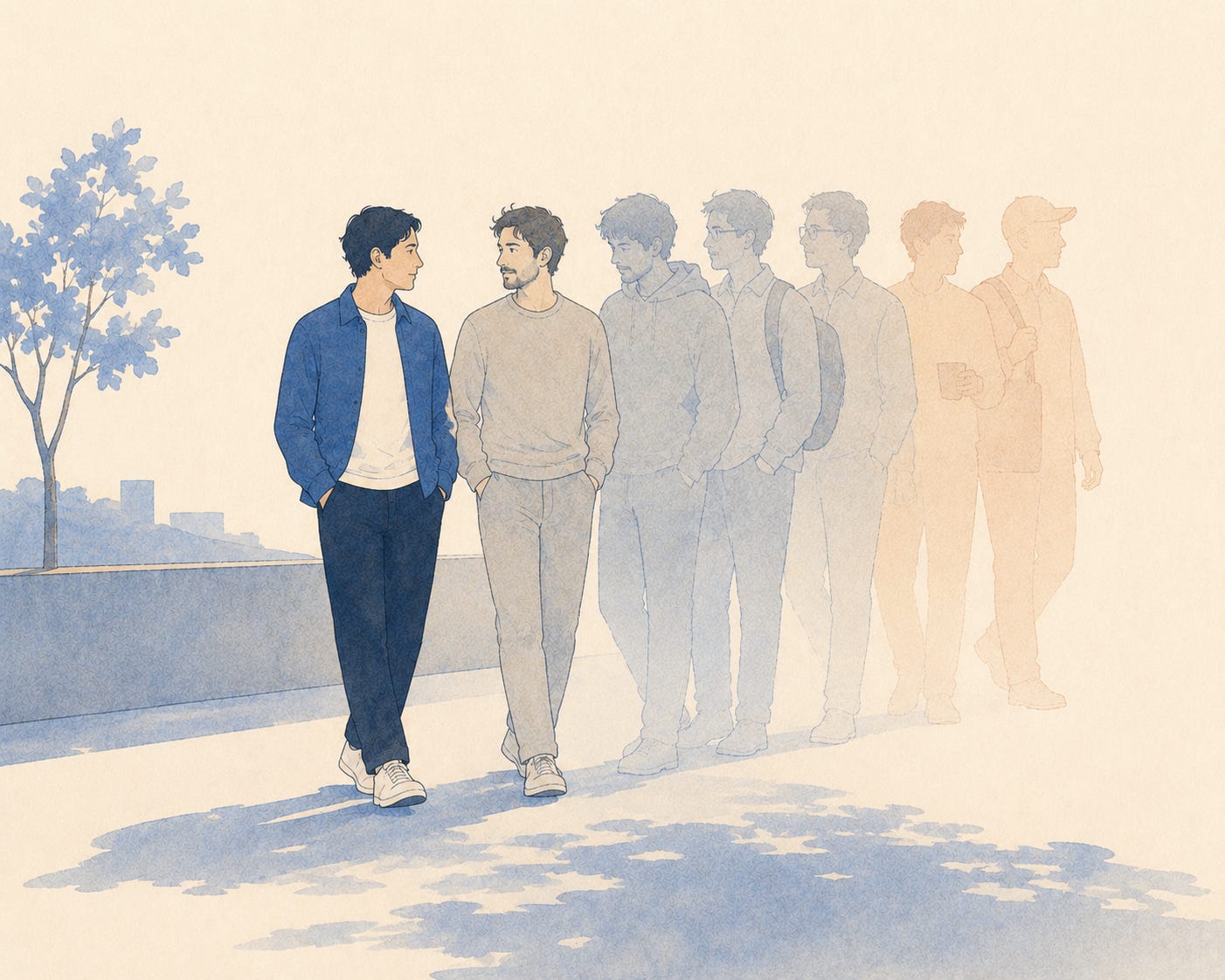
“Don’t walk behind me; I may not lead. Don’t walk in front of me; I may not follow. Just walk beside me and be my friend.” — Albert Camus
There are a few phrases we use more often, and sometimes more casually, than “He’s like a brother to me.” I’ve said it. People have said it about me.
We use it to describe friendships that feel deeper than friendship. Relationships that seem to transcend the usual stereotypes. The people we trust, confide in, build businesses with, travel with, celebrate with, and sometimes grieve with.
For most of my life, I believed in the idea behind those words.
I believed there was a tribe out there. A group of people that would become my chosen family. The people I would navigate life with. The ones who would witness my victories, help carry my failures, and remain standing beside me through the inevitable chaos that comes with being human.
Maybe I picked up that idea from movies, books, or watching groups of friends who seemed inseparable. Or maybe it’s just a story many of us tell ourselves when we’re young and naive.
Whatever the source, I didn’t just value friendship.
I romanticized it.
Some of my friendships became so intertwined with the rest of my life that it became difficult to separate one role from another. We weren’t just friends. We were classmates. Business partners. Confidants. Godparents. Travel companions. Even romantic partners.
The friendships that mattered most weren’t sitting neatly in a box labeled “friendship.” They spilled into everything. And because of that, they felt permanent. Or at least more permanent than they were.
Life, however, has a way of testing the stories we tell ourselves.
Through time, disappointment, distance, conflict, competing priorities, and the occasional crisis. Eventually, reality conducts an audit. And audits have a way of revealing the difference between what exists and what we imagined existed.
Looking back, I don’t think what I was searching for was friendship. I think I was searching for belonging.
Not belonging in the broad sense. Not community, networking, or social connection. Something much more specific. I was looking for my people. The group I would go through life with.
The people who would understand me without requiring too much explanation. The ones who would be there for the important moments and the difficult ones. The people who would tell me when I was wrong, defend me when I wasn’t, and still be around twenty years later.
In my mind, life wasn’t meant to be a solo journey. It was meant to be shared.
I suspect many of us carry some version of that belief. We may not say it out loud, but it’s there in the stories we admire. The band of brothers. The chosen family. The lifelong friends. The team that stays together against impossible odds.
Maybe that’s why friendship occupies such a special place in our imagination. Unlike family, we choose our friends. Or at least we believe we do.
And because we choose them, we often assume those relationships are somehow purer. Stronger. More intentional. As if mutual affection automatically creates mutual commitment. As if closeness guarantees loyalty. As if shared history guarantees a shared future.
For a long time, I believed something along those lines. Not consciously. But it was there. Every friendship wasn’t just a friendship. It was a potential member of the tribe.
Someone who, if enough experiences were shared, enough trust was built, enough years accumulated, might eventually become one of the people who would always be there.
The funny thing is that many of those relationships were genuine. Some lasted decades. Some are still part of my life today. This isn’t a story about fake friendships. It’s a story about the expectations I attached to real ones because those are two very different things.
Some of the most important relationships in my life became difficult to describe. Friend felt too small. Business partner wasn’t accurate. Family wasn’t technically true. And none of those labels captured the reality of what the relationship had become.
Over time, the roles started to overlap. We studied together. Built businesses together. Traveled together. Celebrated milestones together. Introduced each other to new relationships. Supported each other through breakups, losses, and reinventions. Some became godparents to my children. Some became partners in ventures that consumed years of our lives.
In one case, the friendship evolved into something that was, for all practical purposes, a romantic relationship, even if we never formally defined it that way. The boundaries dissolved.
Looking back, I’ve jokingly described some of these relationships as incestuous.
Not in the literal sense, of course. But because everything became connected to everything else. Friendship. Business. Money. Trust. Love. Identity. History. Future plans. Entire chapters of life became intertwined.
At the time, that felt like depth. But I’ve come to think it was also something else. It was concentration.
The relationship wasn’t just carrying friendship anymore. It was carrying expectations from half a dozen categories at once.
When that happens, every success feels bigger. Every betrayal feels deeper. Every misunderstanding carries more weight. Because you’re no longer losing a single relationship. You’re risking an entire ecosystem built around it. The friend. The partner. The advisor. The ally. The witness to your life. All bundled together inside the same person.
And that’s a tremendous amount to ask of any human being. Even the ones we love most.
One of the most interesting friendships in my life is with a man I’ve never met, at least not in any meaningful sense. He insists we crossed paths years ago at some event. He may be right. If it happened, I don’t remember it.
For all practical purposes, our entire friendship has existed online. We’ve been in regular contact for years. We’ve exchanged thousands of messages. We’ve debated politics, philosophy, psychology, business, relationships, parenting, and more subjects than I can count.
Some of our conversations have lasted days. Others have resurfaced years later. He’s one of the most intellectually stimulating people I know. Not because he agrees with me. In many cases, he doesn’t. Some of our best conversations have emerged from disagreement. He sees things differently. Challenges assumptions I didn’t realize I was making. Introduces perspectives I wouldn’t have arrived at on my own.
In many ways, he’s become one of my closest friends. And yet, there are things I know I cannot expect from him. If my car breaks down, he’s not coming to help. If I need someone to pick up my children from school, he’s not the right person. If I have a family emergency, there are practical limitations to what he could do. None of this bothers me.
In fact, I rarely feel disappointed by the relationship. And the older I get, the more I think I understand why. I know exactly what the friendship is.
More importantly, I know what it isn’t.
There is no confusion. No hidden contract. No unspoken expectation that one day he will suddenly become something the relationship was never designed to be.
What we exchange is real. The conversations. The respect. The affection. The intellectual companionship. But the friendship exists within clear boundaries.
And strangely enough, those boundaries may be part of what allows it to thrive. The friendship isn’t trying to be everything. It’s simply being what it is.
That realization has made me wonder how many disappointments in life come not from the relationship itself but from our inability to accept it for what it actually is.
Sometimes we suffer because people fail us. But sometimes we suffer because we quietly promoted them into roles they never applied for and were not capable of fulfilling.
There is something people say to parents that I’ve always found both beautiful and misleading. “If you need anything, call me.” When my children were born, I heard some version of that countless times. People looked me in the eye and genuinely meant it. Or at least I think they did.
The thing is, most of us never test those promises. We receive them as expressions of affection, gratitude, or support. We appreciate them for what they are and move on.
But one day, I actually needed help. Not a dramatic, life-or-death situation. Just one of those moments that arise when you’re raising children and trying to manage the rest of life at the same time.
So I did what people had told me to do. I called.
And what happened next was very educational. Some people didn’t respond. Some responded but couldn’t help. Some had perfectly valid reasons. Some forgot. Others were busy. Some wanted to help but had lives of their own. The details almost don’t matter. What mattered was the realization.
Many of the people who had offered support were not available when it was needed. For a while, I saw that as disappointment. Now I see it differently. Most people weren’t lying. They were expressing a feeling. They were communicating affection. What they weren’t doing was committing.
The problem was that I heard a commitment where they expressed a feeling. And those are not the same thing.
Life creates moments like this in every relationship. Sooner or later, reality arrives and asks a simple question: What exists here beyond the story? What remains once circumstances become inconvenient? What survives contact with competing priorities, limited time, finite energy, and ordinary human self-interest?
That’s what I mean when I say life conducts an audit. Not because life is cruel. Because reality has a way of separating intentions from actions. Feelings from commitments. Affection from sacrifice.
And while those distinctions can sometimes be painful, they’re also clarifying. An audit doesn’t create the truth. It reveals it.
The older I get, the more I find myself returning to a phrase I’ve heard my entire life. “He’s like a brother to me.”
At first glance, it sounds like a statement about closeness. But I don’t think that’s what makes the phrase interesting. What makes it interesting is the word we barely notice.
Like.
The distinction seems small. Until life tests it, a brother may disappoint you. A brother may disappear for years. A brother may frustrate you, betray you, or fail you. But a brother remains your brother. The relationship survives regardless.
Friendships are different.
They exist because two people continue choosing them. And because they are voluntary, they are also conditional in ways we don’t always like to admit.
People enter our lives. People leave. People change. Priorities shift. Families are formed. Businesses are built and dissolved. Interests diverge. Geography intervenes. Entire versions of ourselves come and go. And sometimes relationships that once felt permanent become memories. Not because anyone did anything wrong. Because life happened.
What I’ve come to realize is that many of my disappointments were born from treating “like a brother” as if it meant “brother.” As if affection guaranteed permanence. As if shared history guaranteed future loyalty. As if closeness guaranteed sacrifice. As if love guaranteed alignment. But those assumptions were mine. Not theirs.
The friendship, the care, and the affection were real. The expectations were not.
Because when we call someone a brother, we often aren’t describing the relationship. We’re describing the role we’d like the relationship to play in our lives.
The phrase itself contains the truth. We tend to overlook it.
He’s like a brother.
Not because he is one.
For a period of time, the relationship gave us some of the things a brother might. The mistake is not that friendships fail to become family. Perhaps the mistake is expecting them to.
For a while, I thought these realizations were making me cynical. I thought I was becoming less trusting. Less idealistic. Less willing to believe in people. But I don’t think that anymore.
If anything, I’ve become more appreciative of the relationships in my life. Not because I expect more from them, but because I expect less.
The friend who loves long conversations but disappears when life gets complicated. The friend who would like to get some drinks but would never want to discuss philosophy. The friend who is wonderful in a crisis but absent the rest of the year. The friend I’ve never met but can spend hours exchanging ideas with. The friend who was very important for a chapter of my life and then slowly drifted away. Each relationship offers something. Each has its limits. The problems usually begin when I confuse one for the other.
When I start asking people to play roles they never agreed to play, when I mistake affection for obligation. Closeness for permanence. History for commitment.
These days, I’m less interested in whether someone is “like a brother.” I’m more interested in who they actually are, what they offer. What they don’t. What kind of friendship is possible between us. Not the fantasy version. The real one.
Because the real one is enough; it doesn’t need to become permanent. It doesn’t need to survive every season of life and every version of me to have been meaningful.
Maturity isn’t learning to trust less. It’s learning to see more clearly. To stop asking relationships to become what we need them to be and start appreciating them for what they are.
And when we do that, something unexpected happens.
We become less disappointed by people.
And far more grateful for them.
Recommended Reading
“The Four Loves” by C. S. Lewis
It explores affection, friendship, romance, and charity with remarkable clarity. What makes the book particularly relevant is its ability to distinguish among the different forms of love we often blend. Many of the tensions I explored in Like a Brother emerge because friendship is asked to carry the responsibilities of family, partnership, or romance. This book helps untangle those distinctions.