

Hardware, Software, and the Space Between
Why being human means living between instinct and story.

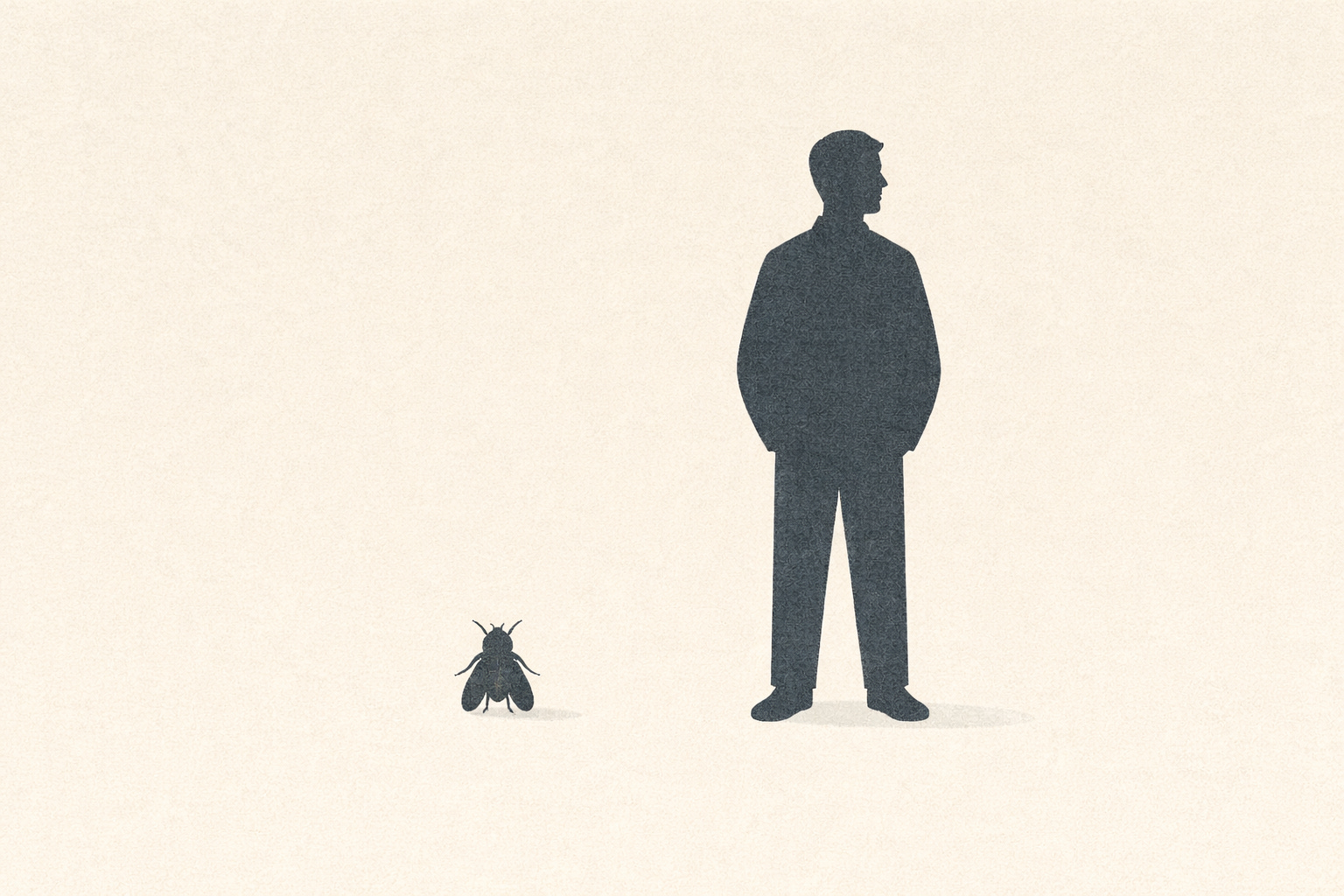
“He who has a why to live can bear almost any how.” — Friedrich Nietzsche
The mayfly has it easy.
It emerges, does what it’s wired to do, finds a mate if it’s lucky, and disappears, all within about twenty-four hours. No second-guessing. No identity crisis. No wondering whether it’s “doing life right.” The program runs, and that’s that.
Humans, on the other hand, run the same basic hardware (hunger, desire, fear, attachment) but with a very different operating system layered on top.
We don’t just feel impulses. We interpret them.
We don’t just want. We ask what wanting says about us.
We don’t just act. We explain why we did it, why we shouldn’t have, and what it means going forward.
Same biology. Very different experience.
It’s tempting to frame this as nature versus nurture, hardware versus software. And that metaphor is useful, up to a point. Biology sets the parameters. Culture, language, and upbringing shape how those parameters are expressed. But what makes the human experience strange isn’t either one on its own.
It’s the space in between.
That narrow gap between impulse and interpretation. Between instinct and story. Between what happens in the body and what the mind does with it afterward. That’s where hesitation lives, and guilt, longing, and creativity. Also, the frustration of knowing exactly what you want, and still not knowing what to do.
The mayfly doesn’t live there.
We do.
And for better and worse, that space is where the rest of the story begins.
Before we talk about stories, interpretation, or meaning, it helps to be clear about what doesn’t change.
The hardware.
We are biological organisms, shaped by millions of years of evolution. We get hungry and tired. We seek pleasure and avoid pain. We attach, compete, reproduce, and protect. These drives don’t ask for permission, and they don’t wait for our philosophies to catch up.
You can reinterpret hunger as “mindfulness,” desire as “attachment,” fear as “ego,” but the sensations still show up. The body doesn’t consult the narrative before acting. It just sends the signal.
This is where much of the confusion starts.
We either try to deny the hardware, pretending we’re more rational, more evolved, more above instinct than we actually are, or we reduce ourselves to it entirely, as if biology alone explains everything worth knowing about us.
Neither works.
Biology doesn’t write the script, but it does define the stage. It sets limits. Timelines. Thresholds. You can’t will yourself out of needing food, connection, or rest any more than a mayfly can decide to live a little longer out of curiosity.
What biology gives us is a range of possible behaviors, not a single destiny. It supplies the raw impulses, not the interpretation. And crucially, it doesn’t tell us what those impulses mean.
That part comes later.
The mayfly executes the program and moves on. No reflection required.
Humans pause.
And in that pause, just long enough to ask “why,” “should,” or “what does this say about me, something different begins to happen.
That’s where the software starts to run.
If biology supplies the impulses, software supplies the commentary.
Language, memory, culture, these don’t just help us communicate. They transform experience itself. The moment we can name something, we can evaluate it. Compare it. Judge it. Store it. Revisit it.
A mayfly feels hunger and acts. A human feels hunger and wonders whether it’s hunger, boredom, habit, or a lack of discipline.
A mayfly mates. A human falls in love, sabotages it, overthinks it, tells a story about why it failed, and then tells another story about why that story was wrong.
This isn’t a flaw. It’s a feature.
The software allows us to delay action, imagine alternatives, and learn from past mistakes. It gives us ethics, art, long-term planning, and the ability to cooperate far beyond immediate instinct.
But it also introduces loops.
We don’t just experience emotions; we reflect on having them.
We don’t just make choices, we judge ourselves for making them.
We don’t just feel pain, we add meaning to it.
Stories don’t replace instinct; they fold back into it. A thought can trigger a bodily response. A memory can produce fear. A narrative about who we are can amplify desire or suppress it entirely.
This is where individuality explodes.
Two humans can share nearly identical biology and still live radically different lives, simply because they’re running different stories. Stories about what’s allowed. What’s dangerous. What’s admirable. What’s shameful. What’s possible.
The more complex the software, the wider the range of outcomes.
Which is why humans don’t just differ in behavior; we differ in interpretation. In values. In identity. In the very way we experience being alive.
The mayfly doesn’t argue with itself.
We do.
And that argument, sometimes productive, sometimes exhausting, is the price of living inside a narrative-rich mind.
There is a narrow space where being human happens.
It’s the moment after an impulse arises but before we act on it. The pause between what the body wants and what the mind makes of it. Between instinct and explanation.
That space doesn’t look like much from the outside. It can last a fraction of a second or stretch on for years. But inside it lives our inner world.
This is where hesitation appears.
Where doubt forms.
Where desire gets tangled with fear.
Where we ask not just what we want, but whether we should want it at all.
The mayfly doesn’t live here. It doesn’t need to. Its life is too brief, its script too tight. The signal comes, the action follows.
Humans linger.
We replay conversations. We imagine alternative futures. We justify, postpone, rationalize, and regret. We stand in that space negotiating with ourselves, sometimes wisely, sometimes endlessly.
This is the space that allows freedom. The ability to choose against impulse. To sacrifice now for later. To say no to something we want because of something we value more.
But it’s also where suffering enters.
Because the same pause that allows choice also allows self-judgment. The same imagination that creates possibility can create anxiety. The same narrative capacity that gives life meaning can trap us in loops of guilt, longing, or self-doubt.
This is the paradox of human consciousness.
The space in between is not a problem to solve. It’s a condition to live with. It’s where creativity, morality, love, and responsibility all emerge, but so do rumination, inner conflict, and the exhaustion of thinking too much about being alive.
We don’t suffer despite this space.
We suffer because we live in it.
And yet, without it, we wouldn’t recognize ourselves.
One of the strangest features of being human is how often reality seems unwilling to cooperate with our stories.
We form expectations about how things should unfold, how people ought to behave, how effort is supposed to pay off, and then feel surprised, even offended, when reality ignores them. As if it had missed a memo.
But reality isn’t disagreeing with us.
It’s simply not following the same script.
Our stories are attempts to predict, to control, to feel safe. Biology wants satisfaction. Narrative wants coherence. And sometimes the two are aligned. Often, they aren’t. We tell ourselves a story about who we are or what we value, only to discover that our actions, desires, or emotions didn’t get the update.
This is where frustration lives.
Not in instinct alone. Not in culture alone. But in the collision between the two, when the hardware keeps sending signals the software would prefer to silence, or when the software insists on meaning the hardware can’t support.
So we negotiate. We rationalize. We rewrite after the fact. We wonder why knowing better doesn’t always translate into doing better.
The mayfly doesn’t experience this mismatch. Its world is brutally simple. Ours is layered.
Reality isn’t broken. It’s just less accommodating than our narratives would like it to be.
And sometimes, learning to live well isn’t about finding the perfect story; it’s about loosening our grip on the ones that keep insisting reality behaves differently.
There’s no uninstalling the software.
There’s no outrunning the hardware.
Being human means living in the space between them, where instinct meets interpretation, and meaning gets negotiated rather than delivered.
That space will never be tidy. It will never stop producing tension. But it’s also the only place where responsibility, creativity, and growth are possible. Without it, we’d have less confusion and far less depth.
The mayfly has clarity.
We have authorship.
Not authorship over biology or reality, but over how we interpret, revise, and respond. Over which stories we tighten around ourselves, and which ones we allow to remain provisional.
I believe learning to live well isn’t about choosing hardware or software. It’s about becoming fluent in the space between them and knowing when to listen to the body. When to question the story. When to let reality disagree without taking it personally.
We don’t get certainty.
We get something better: the ability to notice what’s happening, pause, and choose our following line a little more carefully.
And that, for better and worse, is the privilege of not being a mayfly.
Recommended Reading
“Behave” by Robert Sapolsky
This is a book for anyone who’s ever wondered why knowing better doesn’t always mean doing better. Robert walks through human behavior layer by layer (neurons, hormones, evolution, culture), showing how no single level explains us fully. It’s a reminder that being human is less about finding one cause and more about learning to live with complexity.